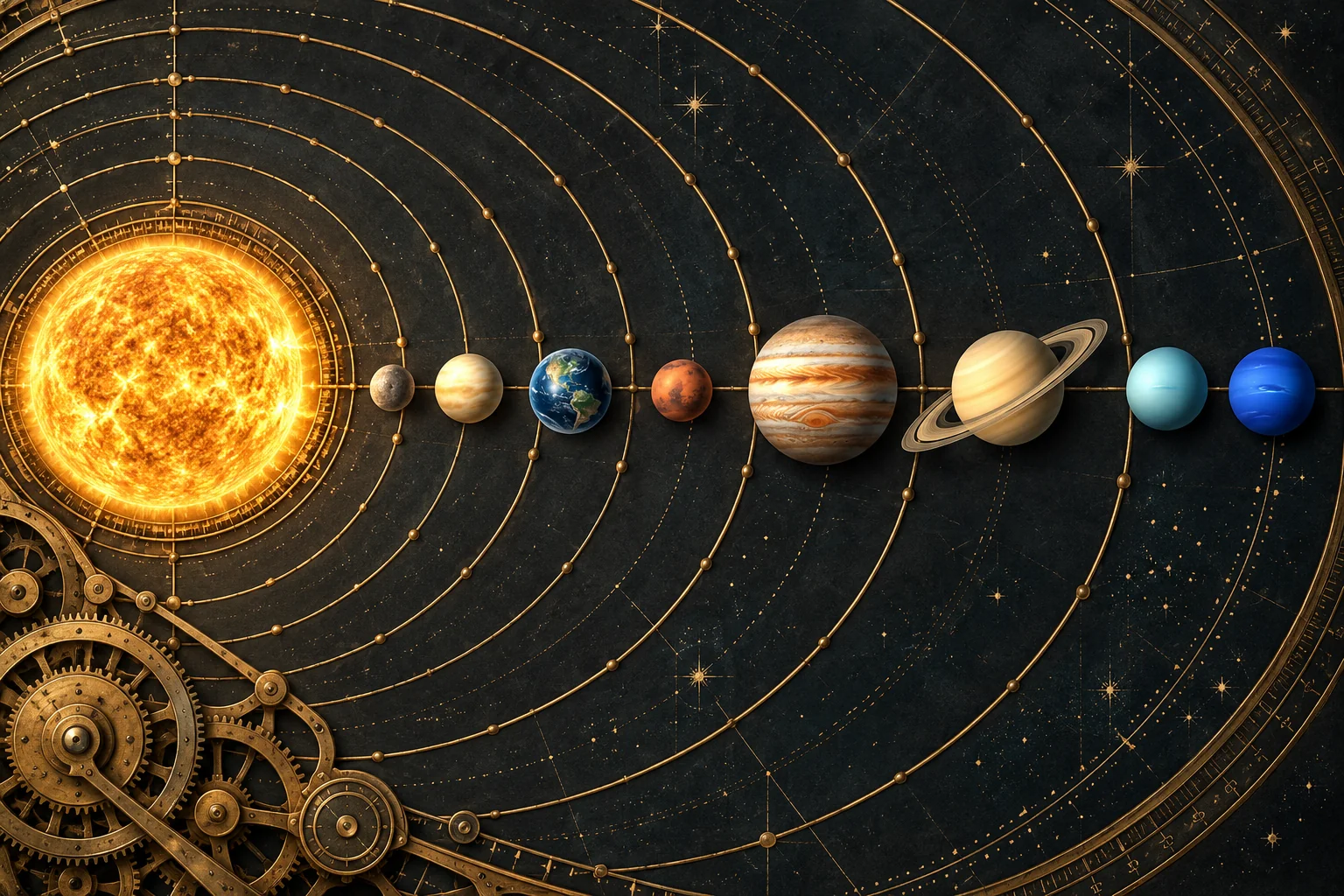
An orrery turns time into position. Whether it uses brass gears or software and light, it begins with the fact that every planet has a characteristic orbital period. The instrument advances each planet by the right amount, then presents the resulting arrangement in a model people can understand.
Mechanical orreries encode motion in gears
In a traditional orrery, a central drive turns a train of gears. The number of teeth in each pair establishes a ratio, so one arm can complete a circuit while another moves only a fraction as far. Carefully chosen ratios approximate the planets’ years. Arms carry small planet models around a central Sun, and a hand crank or clockwork advances the entire system from a known starting date.
A simple model may use circular, coplanar paths. More elaborate instruments add eccentric mechanisms, inclined rings, rotating planets, and moons. Every extra motion adds parts, friction, and calibration work, which is why even fine historical orreries make deliberate simplifications.
Electronic orreries calculate the angle
An electronic orrery performs the equivalent work in mathematics. Software starts with the date and a description of each orbit. In a common approximate method, it updates the orbital elements for the date, solves Kepler’s equation, calculates coordinates in the orbital plane, and transforms them into a shared ecliptic reference frame.
The planet’s heliocentric longitude can then be mapped to an angle around a display. A motorized electronic model might rotate physical arms to those angles. A light-based model illuminates the point that represents each angle, avoiding a nested mechanical assembly.
Position requires a reference frame
Most orreries show the Solar System from a heliocentric viewpoint. The Sun is the origin, and the planet positions are measured around it. A star chart uses a different frame: it shows where objects appear from Earth. The two views cannot be substituted without accounting for Earth’s own position and the observer’s line of sight.
The “top” of a heliocentric display also needs a reference direction. Astronomical coordinates commonly use a defined equinox and reference plane, such as the mean ecliptic and equinox of J2000. That fixed framework gives calculated longitudes a consistent orientation instead of allowing the entire diagram to rotate arbitrarily.
What the display scales—and what it does not
A compact orrery cannot show planet diameter and orbital distance at the same physical scale. Neptune would be extremely far away while rocky planets became almost invisible. Designers therefore exaggerate planet markers and compress or equalize orbit radii. Many displays focus on angular position because conjunctions, alignments, and relative motion remain legible.
Time can be scaled too. Real-time motion is authentic but nearly imperceptible for the outer planets. An accelerated mode preserves the relative orbital rates while letting a viewer watch years pass in minutes.
How OrbiKron maps the planets
OrbiKron uses GPS time and astronomical calculations rather than a gear train. It maps the calculated heliocentric position of each of the eight planets to a field of 241 LEDs, using distinct colors to keep the planets identifiable. The display represents orbital angle, not literal interplanetary distance or planet size.
In Real Time mode, the lights show the arrangement for the present date. Fast mode advances the same model rapidly, making the contrast between short inner-planet years and long outer-planet years visible. It is the old purpose of an orrery—understanding motion through a working model—translated into electronics and light.
Press OrbiKron’s hidden button to activate Above Horizon Mode. Planets that have set below the local horizon or are occluded by the Sun appear in deep dark red, while the rest stay at full brightness. This observer-centered view complements the orrery’s Sun-centered orbital map.