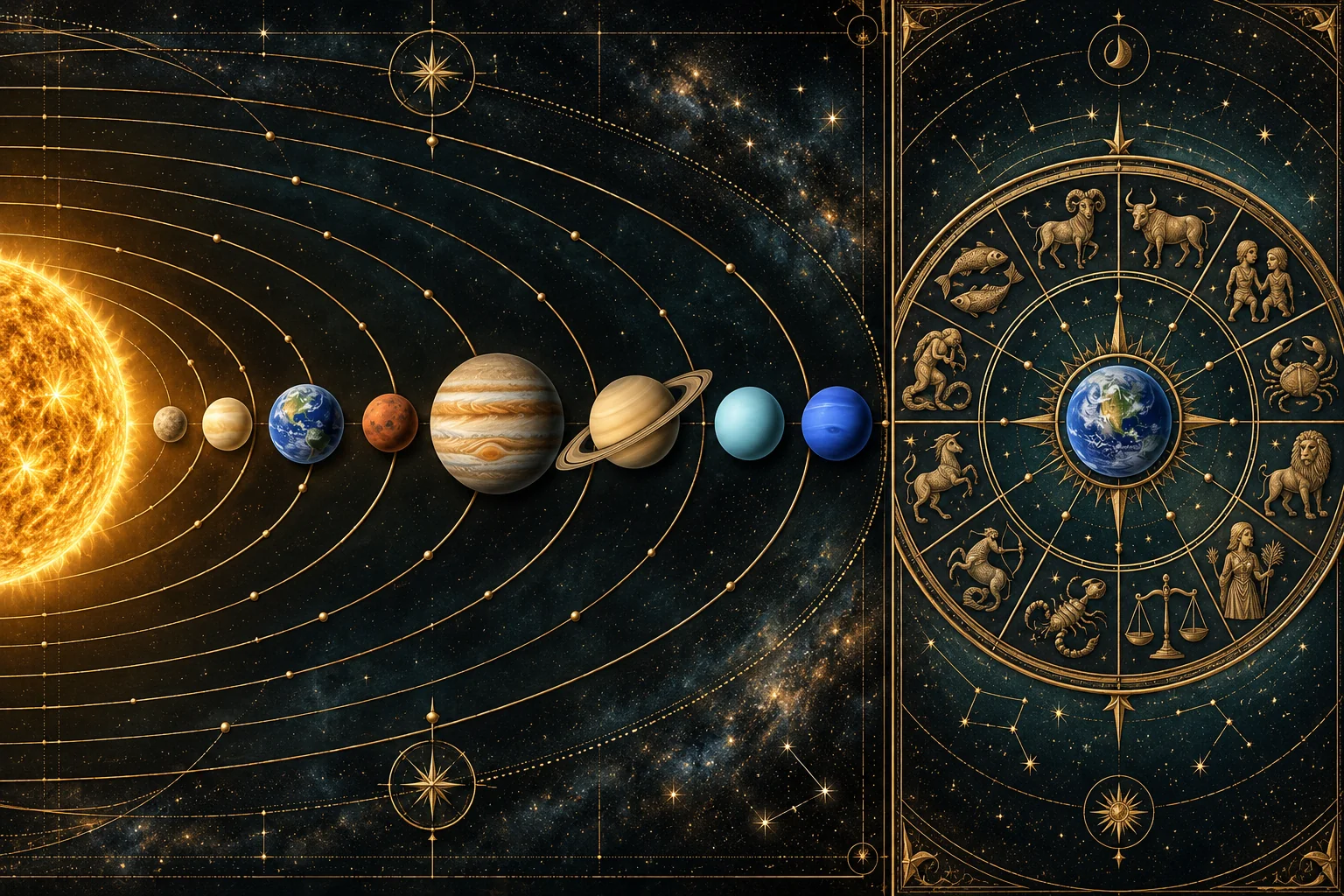
Why doesn’t OrbiKron show zodiac signs or tell you when Mercury is in retrograde? It is designed as a heliocentric astronomical orrery: a model of the planets moving around the Sun. A conventional astrology chart uses an Earth-centered viewpoint and adds symbolic interpretations. The difference involves both where you measure from and what you want the display to explain.
A Sun-centered model of planetary motion
Heliocentric means “Sun-centered.” In an orrery, the Sun anchors the display and Earth takes its place alongside the other planets. Each planet’s position shows where it is in its orbit around the Sun at a particular time. This makes the differing lengths of planetary years and the changing arrangement of the Solar System visible.
OrbiKron translates calculated heliocentric orbital angles into colored light for all eight planets, from Mercury through Neptune. Its orbit spacing and planet markers are display choices, rather than a scale model of distances or sizes. Real Time mode follows the present date; Fast mode accelerates the model so you can watch planetary motion unfold.
An Earth-centered chart of the sky
Geocentric means “Earth-centered.” Most familiar astrology charts describe the directions of the Sun, Moon, and planets as seen from Earth, placing them within a zodiac. A natal chart records those positions for a birth date and time; its ascendant and houses also depend on the location and the chosen house system. Astrologers then assign meanings to signs, houses, and angular relationships called aspects.
Using Earth as a viewpoint does not require believing that the Sun physically orbits Earth. Modern astronomy also uses geocentric and observer-centered coordinates to describe the sky. The distinction is that astronomy measures and explains celestial phenomena, while astrology interprets them in relation to personality or human events. Accurate planetary calculations do not establish those interpretations; astrology’s predictive claims are not supported by scientific evidence. NASA explains the distinction between astronomy and astrology.
Why the same planet can occupy different angles
Imagine looking at Mars from the Sun, then looking at it from Earth. The two lines of sight start at different places, so their directions are usually different. To obtain a geometric Earth-centered position from Sun-centered coordinates, you subtract Earth’s position from the planet’s position. Precise apparent positions involve additional corrections, such as light-travel time.
Consequently, a planet’s angle on OrbiKron cannot simply be read as its placement in an Earth-centered zodiac chart. Adding zodiac labels around the orrery would not turn those heliocentric angles into conventional astrological positions.
Retrograde motion is a change in apparent direction
When Earth overtakes Mars in its inner, faster orbit, Mars can appear to move backward against the distant stars for a time. This is apparent retrograde motion: a consequence of watching another moving planet from our own moving planet. Mars continues traveling around the Sun in the same orbital direction throughout. The University of Nebraska–Lincoln’s heliocentric model illustrates this geometry.
An Earth-centered chart can record that apparent reversal. A heliocentric orrery shows the underlying orbital motion, so Mars does not reverse around the Sun when it is described as “retrograde” in astrology. The two displays represent different measurements of the same motion.
Zodiac signs are another layer of convention
Astrological signs are not interchangeable with astronomical constellations. Both tropical and sidereal astrology divide the zodiac into twelve equal signs. The tropical zodiac starts at the March equinox; sidereal systems use a reference tied to the stars. Astronomical constellations occupy unequal regions of the sky. Astrodienst describes these conventions in The Three Zodiacs in Astrology.
Some astrologers also use heliocentric charts. That is a reminder that the coordinate system alone does not decide whether something is astronomy or astrology: the purpose and interpretation matter too.
Why OrbiKron follows astronomical time
OrbiKron’s purpose is to make planetary motion and orbital cycles tangible. It does not calculate natal charts, assign zodiac signs, or interpret alignments as predictions about people. Supporting conventional astrology would require a different presentation: Earth-centered positions, a selected zodiac, and chart-specific calculations and interpretation.
Above Horizon Mode adds a local observational feature. Pressing the hidden button dims planets below your local horizon or occluded by the Sun to deep dark red. This changes their brightness while keeping the heliocentric arrangement; it does not convert the display into an astrology chart. Whether you enjoy astrology as a cultural tradition or simply love the night sky, OrbiKron offers a way to watch the Solar System’s motion.