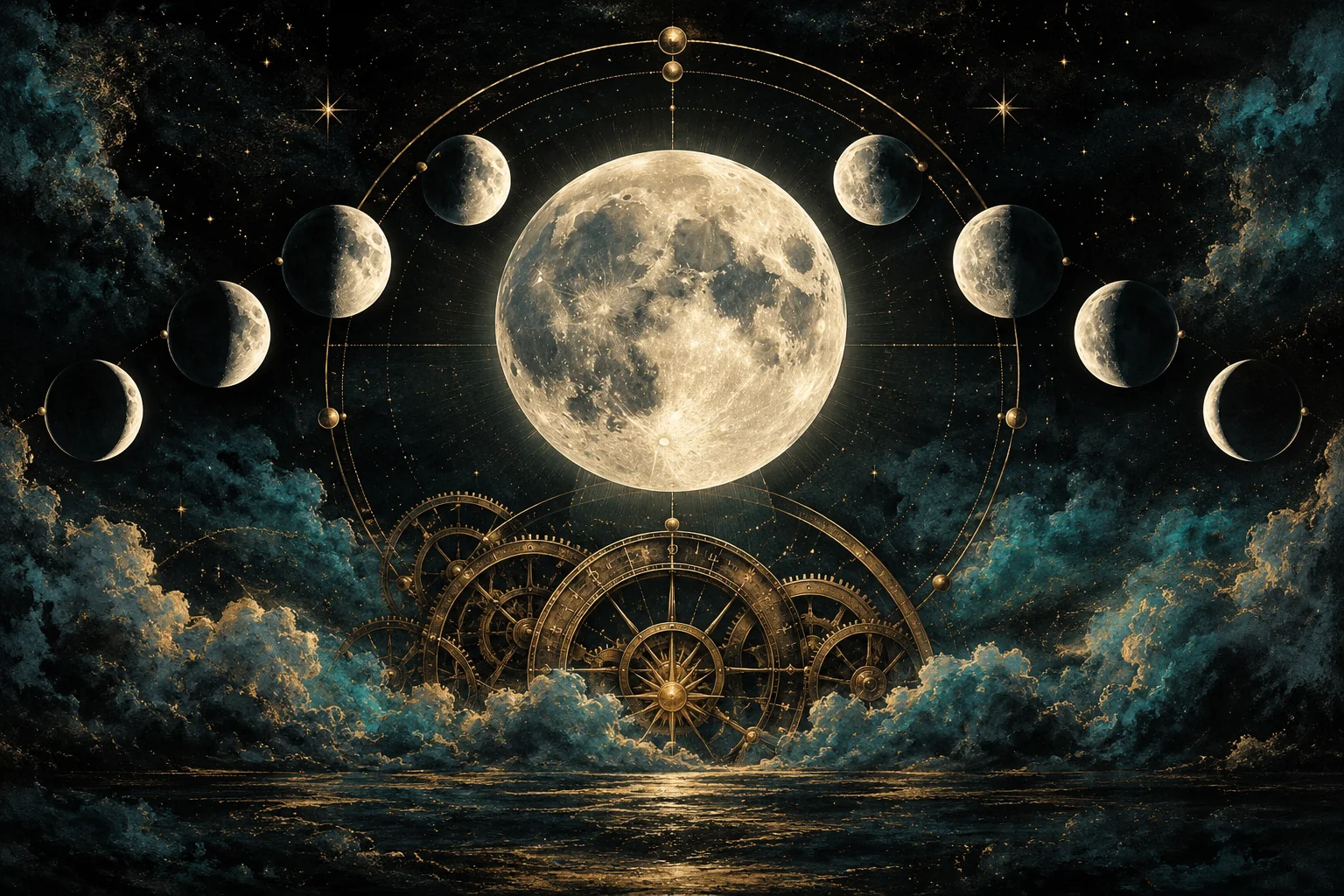
A moon phase clock tracks the changing portion of the Moon illuminated as seen from Earth. It does not measure moonlight. It advances through a model of the lunar cycle, starting from a known phase and using either a geared mechanism or an astronomical calculation to stay aligned.
Moon phase comes from geometry
Half of the Moon is always illuminated by the Sun, except during a lunar eclipse. The phase we see depends on the angle between the Sun, Moon, and Earth. Near new moon, the illuminated half mostly faces away from us. As the Moon moves eastward around Earth, the visible illuminated portion waxes through crescent and first quarter to full, then wanes back through last quarter.
The cycle from one new moon to the next is the synodic month. Its mean length is about 29.53059 days. This is longer than the Moon’s approximately 27.3-day orbit relative to the distant stars because Earth and the Moon have moved along Earth’s orbit around the Sun; the Moon must travel farther to recreate the same Sun–Earth–Moon angle.
How a mechanical moon phase works
A traditional watch or clock often places a painted moon disk behind a shaped aperture. A common mechanism advances a 59-tooth wheel once per day. Two moon images on the disk make one displayed cycle take 29.5 days—an elegant approximation to the synodic month.
The missing 0.03059 day is small, but it accumulates. A simple 29.5-day mechanism drifts by roughly one day in about two years and eight months if it runs continuously. More elaborate gear ratios reduce that error dramatically, but the display still needs the correct phase when it is first set and after it stops.
Calculated moon phase clocks
An electronic clock can begin with an accurately timed reference phase and calculate the fraction of the synodic cycle that has elapsed. More complete astronomical algorithms account for variations in the Moon’s orbit rather than treating every lunation as exactly the mean length. The result is then translated into a graphic, illuminated segments, or a shaded Moon image.
The display resolution matters. A clock with eight distinct phases communicates the familiar sequence clearly, while a higher-resolution matrix can show a smoother terminator—the boundary between lunar day and night. Neither is intended to reproduce every feature seen through a telescope; both turn the cycle into an ambient indication.
Timekeeping and location
The basic phase is nearly the same for everyone on Earth at a given instant, so latitude and longitude are less central than they are for sunrise or tide predictions. Accurate time is still important. A connected clock may obtain it from a network, while a self-contained design can receive it from GPS. Time zones affect how a calendar date is labeled, not the physical Sun–Moon geometry at that instant.
How LunaKron differs
LunaKron uses GPS time and calculates the current lunar phase automatically. There is no moon disk to reset, app to pair, or Wi-Fi network to configure. Hidden LEDs translate the calculation into an illuminated Moon: the LunaKron series offers both an eight-phase linear form and higher-resolution square displays.
The technology stays in the background. What remains visible is the slow progression from new to full and back again—the same purpose served by a mechanical moon phase, without depending on a hand-set calendar or an approximate 59-tooth cycle.